Start with a name
Village Finder
Find the home village in Japan. From your immigrant ancestor's name, we find the record that names the village he or she came from. We read it in English and tell you where the family's koseki is kept today.
Village Finder — $99, and you pay only if we find the village. PDF, usually 4–6 pages. We reply within a week; if we find the village, the report follows about a week after you pay. About this service
This sample shows the Ando family of our other samples. The family is fictional, so the entries below were written for this sample, in the form each record uses. The kinds of records and how they are laid out are real. In your own report, a copy of the record itself is included for your family's personal use.
Village Finder
ANDO Kisaburō: the village he came from
An immigrant to Hawaii, traced to his home in Japan
| Immigrant | ANDO Kisaburō (安東喜三郎), born about 1882 |
|---|---|
| Went to | Hawaii, about 1905; lived at Waipahu, on the island of Oahu |
| Found in | A passenger arrival list, Honolulu, April 1912 |
| Home | Nagaiwaya (長岩屋), a hamlet of Nishi-Tomiku Village (西都甲村), Nishi-Kunisaki District (西国東郡), Oita Prefecture |
| Today | Bungo-Takada City (豊後高田市), Oita Prefecture |
| Prepared for | [client name withheld] |
綴Koseki Roots
At a glance
- Kisaburō went back to Japan, married Yoshino (ヨシノ) there in 1912, and returned to Hawaii with her that April.
- The passenger arrival list of that voyage names his home: Nagaiwaya, in Nishi-Tomiku Village, Oita Prefecture.
- It also names his brother in the village, ANDO Kiichi (安東喜一).
- Nishi-Tomiku Village is now part of Bungo-Takada City, whose city hall keeps the old koseki.
How to read this. We show the record as it was written, then what each part means. Our own conclusions are under "Our reading." Japanese names are written surname first, as in Japan: ANDO Kisaburō is Mr. Ando.
1. What your family told us
- Name: Ando Kisaburō. The family knew him as "Grandpa Kisaburo."
- Came to Hawaii around 1905, from somewhere in Oita.
- Lived and worked at Waipahu. Kisaburō's wife: Yoshino. Eldest son of Kisaburō and Yoshino: Isamu, born 1917.
- The family remembered that he "went back to Japan once to get married."
That last memory pointed to the right list. The passenger arrival lists of 1905 seldom give more than "Japan". The lists from 1907 onward add two columns: the passenger's last home, and the nearest relative in Japan.
2. The record: arriving at Honolulu, April 1912
The passenger arrival list of the ship that reached Honolulu in April 1912. Kisaburō and Yoshino are on two lines next to each other. The officers wrote the place names in Roman letters: mura means village, gun district and ken prefecture. Section 3 gives them in Japanese.
| Column | Kisaburō | Yoshino |
|---|---|---|
| Name | Ando Kisaburo | Ando Yoshino |
| Age | 29 | 18 |
| Occupation | laborer | wife |
| Last residence | Japan — Nagaiwaya, Nishitomiku mura | Japan — Nagaiwaya, Nishitomiku mura |
| Nearest relative in Japan | Brother, Ando Kiichi, Nagaiwaya, Nishitomiku mura, Nishikunisaki gun, Oita ken | Brother-in-law (her husband's brother), Ando Kiichi, same address |
| Going to | Hawaii, Waipahu | Hawaii, Waipahu (husband) |
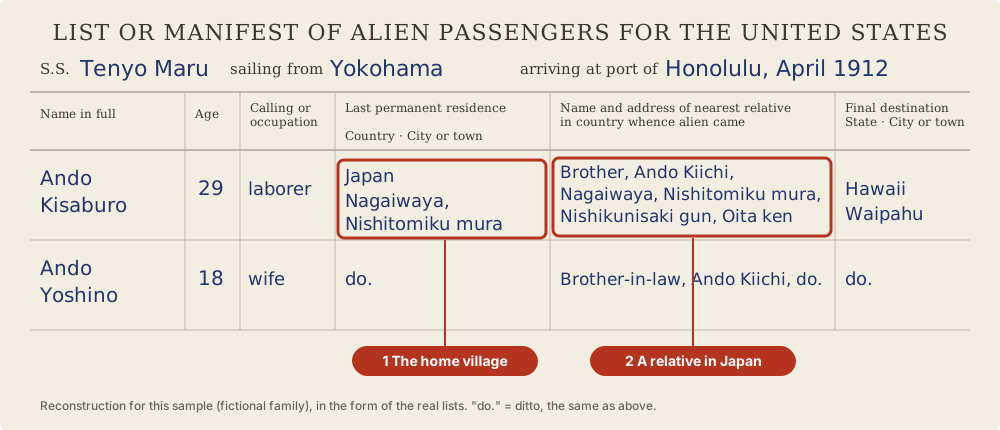
Yoshino's line gives the same village as his, not her own. When she married, she entered his family's koseki, and the list gives that family's home. Her own family's village is written in the koseki itself.
Our reading
The name, the age (29 in 1912, so born about 1882), the wife's name and the destination, Waipahu, all agree with what your family told us, so we treat this as your Kisaburō.
3. The place names, back in Japanese
In Japanese, the names read from the smallest place to the largest:
| On the list | In Japanese | What it is |
|---|---|---|
| Ando Kisaburo · Ando Yoshino · Ando Kiichi | 安東喜三郎・ヨシノ・安東喜一 | The three people the list names |
| Nagaiwaya | 長岩屋 | The hamlet, a part of the village |
| Nishitomiku mura | 西都甲村 | Nishi-Tomiku Village |
| Nishikunisaki gun | 西国東郡 | Nishi-Kunisaki District |
| Oita ken | 大分県 | Oita Prefecture |
4. The village today, and where the koseki is kept
The list gives his home, not his registered domicile (honseki: the address under which a family's koseki is filed). Here the two are very likely the same: his brother Kiichi was the head of the household in Nagaiwaya. The koseki itself is where to check.
Nishi-Tomiku Village joined Takada Town in 1951, and in 1954 Takada Town became Bungo-Takada City. Nishi-Tomiku is no longer a municipality, but the hamlet of Nagaiwaya is still there, in the hills of the Kunisaki Peninsula.
The old koseki of the Ando family of Nagaiwaya is kept by Bungo-Takada City Hall. A direct descendant can request it by mail from abroad. Ask for the old registers filed at Nagaiwaya with ANDO Kiichi as head of household, and for Kisaburō's own register. Our free guide, How to get a koseki from abroad, explains what to send and how to pay. In your report, this section names your own city or town hall and its address.
5. Where it leads
- The registers. Kisaburō's koseki names his parents, his brother Kiichi and, through Yoshino's entry, her own family's village. A Koseki Family Tree reads it in full.
- Back to the village. A Roots Report tells the story of the Ando name in Nagaiwaya and of the families of that name in the records, back through the centuries. A Hometown Visit Guide can take you there.