Step 1
Roots Snapshot
A quick first look. For anyone starting from a family name and a town, village or prefecture.
Download this sample as delivered (PDF, 0.6 MB)
Roots Snapshot
The Ando families of Nagaiwaya 長岩屋の安東一族
Where the Ando name is found, and the village of Nagaiwaya in brief
| Registered domicile (honseki) | Nagaiwaya, Bungo-Takada City, Oita Prefecture |
|---|---|
| Prepared for | [client name withheld] |
| Date | October 5, 2026 |
Sample. The family name and registered domicile are fictional; the places, records and research are real.
綴Koseki Roots
At a glance
- Your family's registered domicile (honseki) is Nagaiwaya (長岩屋), a village in a valley of the Kunisaki Peninsula, Oita Prefecture.
- Oita has more people named Ando (安東) than any other prefecture, about 4,600.
- The village temple is Tennenji (-ji means "temple"), about 0.6 km from the registered domicile.
- At Sano (佐野), a hamlet about 9 km away, an Ando fought in 1580 for the Ōtomo, the warlords who ruled Bungo (the old province, now Oita Prefecture). An Ando family there, the Ando of Sano, is said to have served as village headmen (hereditary village officials) in the Edo period.
- This Snapshot tells the story of your surname and its village. Links to older families are drawn as a dotted line.
- Your koseki goes back to the 1886 registers, which often name ancestors born in the early 1800s; earlier registers have been withheld from everyone since 1968 (see Background in brief).
- The link to these older families usually rests on where the name is found, not on documents, so a Roots Report or Family Chronicle draws it as a dotted line.
How to read this Snapshot. Where we state something plainly, it rests on records written at the time, or on the district gazetteer's account of them. The gazetteer is a local encyclopedia of the district, compiled in the early 20th century. "Is said" marks later histories and local tradition, and our own inferences are under "Our reading."
Dates are month first, as in North America. Japanese terms and periods are explained in Background in brief, with a timeline.
Distances are in kilometers, in a straight line (1 km is about 0.6 mi).
Where the Ando name is found
About 16,700 people in Japan bear the surname Ando, so Oita's 4,600 are more than a quarter of them. Within the prefecture, the share of Ando households is highest in Usuki City and Ōno Town in the south. Bungo-Takada City, which includes Nagaiwaya, comes next. Some 300 people of the name live in the city, and Ando families still live in the Tomiku (都甲) valley around Nagaiwaya. Takada, the old town center of the city, lies about 9 km (6 mi) from the village.
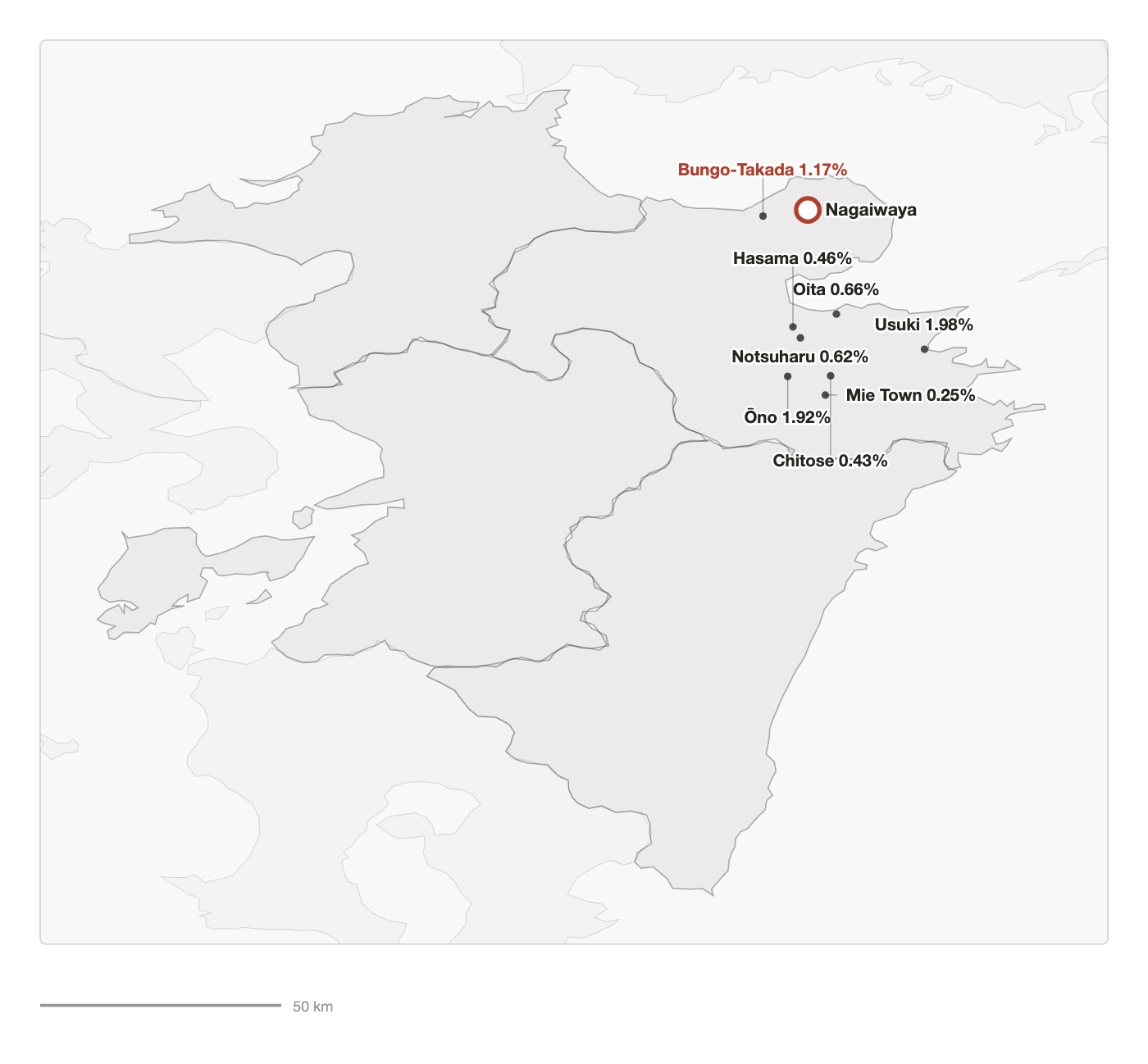
| Town | Households | Share | From the village |
|---|---|---|---|
| Usuki City | 192 | 1.98% | ~55 km |
| Ōno Town, Ōno District | 34 | 1.92% | ~60 km |
| Bungo-Takada City | 60 | 1.17% | Village is in the city; center (Takada) ~9 km |
| Oita City | 512 | 0.66% | ~38 km |
| Notsuharu Town, Oita District | 9 | 0.62% | ~46 km |
| Hasama Town, Oita District | 15 | 0.46% | ~42 km |
The place called Nagaiwaya
Nagaiwaya was a village in its own right until 1889 and is now part of Bungo-Takada City. It lies in a valley at the center of the Kunisaki Peninsula, on the upper reaches of the Tomiku River, which flows west from Mount Futago. The district gazetteer describes the valley as a gorge about 4 km long, with cliffs 60 m (about 200 ft) or more high. The gorge was once known as "Tomiku-yaba" (yaba: a gorge of towering rock formations).
In 1285 a land register of the province listed Nagaiwaya as part of the Tomiku estate (shōen, a medieval landholding worked by local families). The estate covered seventy chō of fields (about 70 hectares, or 170 acres). It belonged to Usa Mirokuji, a Buddhist temple attached to the great Usa Shrine (a shrine is Shinto; a temple is Buddhist).
In the Edo period the area belonged to the Shimabara domain (the Matsudaira clan), one of some 260 domains ruled by hereditary lords under the shogun (Japan's military ruler). Shimabara's castle was in today's Nagasaki Prefecture, and this corner of Kunisaki was one of its outlying territories. Mergers between 1875 and 1954 brought the village into Bungo-Takada City; the older names are on the cover.
The village temples and festivals
Tennenji is a temple of the Tendai school, one of Japan's major Buddhist schools. Its mountain name (sangō: a formal second name that Japanese Buddhist temples carry, ending in -san, "mountain") is Nagaiwaya-san.
It belongs to Rokugō Manzan, a network of Tendai mountain temples unique to the Kunisaki Peninsula and recorded since the 8th century. Each New Year the temple holds a fire festival with dancers dressed as demons, the Shujō Onie. In 1977 the festival was designated an Important Intangible Folk Cultural Property of Japan, under the wider name Kunisaki Shujō Onie. A second Tendai temple, Chōanji, stands about 0.9 km from the registered domicile.
The families of the name, in brief
The Nagaiwaya Ando made their home in the Tomiku valley, a place recorded since the Kamakura period (1185–1333). In 1580 a lord of Kunisaki who had rebelled against the Ōtomo (大友) held Kurakake Castle (鞍懸城) at Sano, and the Ōtomo laid siege to it. This was late in the Warring States period (Sengoku, c. 1467–1600).
Nine letters from the campaign survive, and in the early 20th century two families in Takada held them. Most are addressed to Ando Kunai (安東宮内丞), a local warrior who fought for the Ōtomo.
Why a shared name in one village matters. In Japan, a surname shared within one village means more than it usually does in North America. Japan has well over 100,000 different surnames, many of them taken from place names or features of the landscape. Names also stay close to where they began: Oita alone, one of Japan's 47 prefectures, is home to more than a quarter of the 16,700 people named Ando. In many rural areas a main household and its branch households shared one surname and lived in the same village for generations. People of that name there were often related.
Young people often left to work in nearby towns, and later some went abroad, but the household itself was usually carried on in the village by its heir. That is why emigrants stayed on their village's register. Sano lies 9 km from Nagaiwaya, in the same district (the old county that grouped the villages). The link between the two rests on nearness and on where the name is found, so the chart in a Roots Report draws it as a dotted line.
Our reading
The Nagaiwaya Ando may connect to Kunai's line or to the Ando of Sano: they share the surname, and Sano is close by. Before the 1886 registers, temple records may help, if they survive.
Background in brief
The records. The koseki records every birth, marriage, adoption and death in a household. Japan's first registers (1872) have been withheld from everyone, descendants included, by the Ministry of Justice since 1968, because they recorded former social status (such as samurai or commoner). The oldest registers you can request are therefore the 1886 format. These still name people born well before 1886, often a household head born in the early 1800s.
Under an older rule, a register was kept for only 80 years after everyone in it had died or moved away (the rule is now 150 years), and then discarded. So in some families the oldest register that survives is a later one, such as the 1898 format.
For the time before these registers, we turn to sources from the Edo period. These are the temple's death register and memorial tablets, the village's religious census, the domain's land surveys, and, for a few families, letters and land deeds handed down for centuries. Memorial tablets (ihai) are wooden tablets on the family altar (the Buddhist altar in a home) bearing a dead person's name and death date. The religious census (shūmon aratame-chō) was the Edo-period household count taken through the temples. The gazetteers we cite collected many of these.
A Roots Report tells you which of these records exist for your village. A Family Chronicle, our book about the families of your name in the village, works through what they say. These records describe the families who carried the name in the village and give the story of your name its setting.
A single line can be followed through these records only where the headship (the position of family head) passed unbroken from one designated heir (chakushi) to the next. The family must also have kept its records the whole time. Across the Edo period alone, that could mean fifteen generations or more.
Few families managed it, samurai and court families included. Moves to a new domain, fires, a family dissolved by its lord, a samurai left without a master, or a turn to farming broke the chain for most.
The emigration years. Government-sponsored emigration to Hawaii began in 1885, mostly from Hiroshima, Yamaguchi, Kumamoto, Fukuoka and later Okinawa. The mainland US and Canada followed in the 1890s, Brazil from 1908. Emigrants remained listed in their home village's register, even overseas. That is why the koseki of a family that left in 1905 still sits in a city office in Japan, and why its registered domicile (honseki) is where a search begins.
Terms used
- Kamakura period (1185–1333)
- The first warrior government; land registers and estate records begin naming local families.
- Warring States period (Sengoku, c. 1467–1600)
- Central power collapses and regional warlords fight for territory; local land-holding families fight for them in return for land.
- Edo period (1603–1868)
- Two and a half centuries of peace under the Tokugawa shoguns. Villages are taxed in rice and run by hereditary headmen.
- Domain (han)
- One of about 260 fiefs ruled by hereditary lords (daimyo) under the shogun. A village "belonged" to a domain, which taxed it.
- Village headman (shōya)
- The hereditary local official who ran a village for the domain: taxes, disputes, records. The post went to a leading farming family of the village.
- Ōtomo clan
- The warlords who ruled Bungo (today's Oita) and much of northern Kyushu (Japan's southwestern main island) for 400 years until 1593.
- Estate (shōen) · chō
- A medieval landholding owned by a temple, shrine or noble family. 1 chō ≈ 1 hectare (2.5 acres).
- Gazetteer
- A local encyclopedia of a district or prefecture, compiled from older documents and local tradition.
More in our glossary.
If you know only the prefecture
Where the Ando name is concentrated in Oita
Oita Prefecture has about 4,600 people named Ando, more than any other prefecture. By share of Ando households, the towns rank like this:
- Usuki City (1.98%): the highest share in the prefecture, in the south.
- Ōno Town (1.92%): almost as high, also in the south.
- Bungo-Takada City (1.17%): the next highest, in the Kunisaki Peninsula.
- Oita City (0.66%): the most Ando households (512), but a small share of a large city.
- Notsuharu and Hasama (0.62% and 0.46%): two small towns in Oita District.
Two areas stand out: Usuki and Ōno in the south, and Bungo-Takada City in the Kunisaki Peninsula. With the prefecture alone, both areas remain possible, and we leave the choice open.
Clues that name the village
The village is most often named in family papers. Look for these:
- A passport from the emigration years.
- An immigration record.
- A wartime record.
- A gravestone.
- A memorial tablet (ihai), kept on the family altar.
The village name may be written in Japanese characters. A photo of the paper is enough for us to read it.
Next steps
- Look through the family papers above for the village name. Our free guide, How to find your honseki, shows where to look.
- If you find it, send it to us. With the village name, a Roots Report can go into the village, its temples and its records.
- Before you pay for a Roots Report, we tell you by email what it can cover with what you know.
About the Roots Snapshot
This Snapshot summarizes what published records alone show, before any koseki is examined. The Roots Report takes it much further. It maps the surname down to the hamlet and names the likely family temples. It also follows records of the name from the Edo-period village back to the medieval and Warring States periods.
Get a Snapshot for your name and village — $29
All we need is your ancestor's surname and town or village. If you know only the prefecture, we can still begin; for common surnames, this may not narrow down to one town.