Single request
Document Reading
A photo, gravestone or letter. We read the writing on the back of a photo, a gravestone, a memorial tablet or one old letter. A memorial tablet (ihai) is a wooden tablet on the family altar bearing a dead person's name and death date.
Download this sample as delivered (PDF, 1.0 MB)
Document Reading
The writing on the back of a photograph
Two lines in Japanese, transcribed, translated and explained
| Item | A photograph on a stiff card backing, with two lines written in pen on the back |
|---|---|
| Images | 2 (front and back) |
| Prepared for | Grandma Amy, from Ken and Lisa |
| Date | October 2026 |
Sample. The gift names on the cover are fictional; a gift order shows the names you give us.
綴Koseki Roots
At a glance
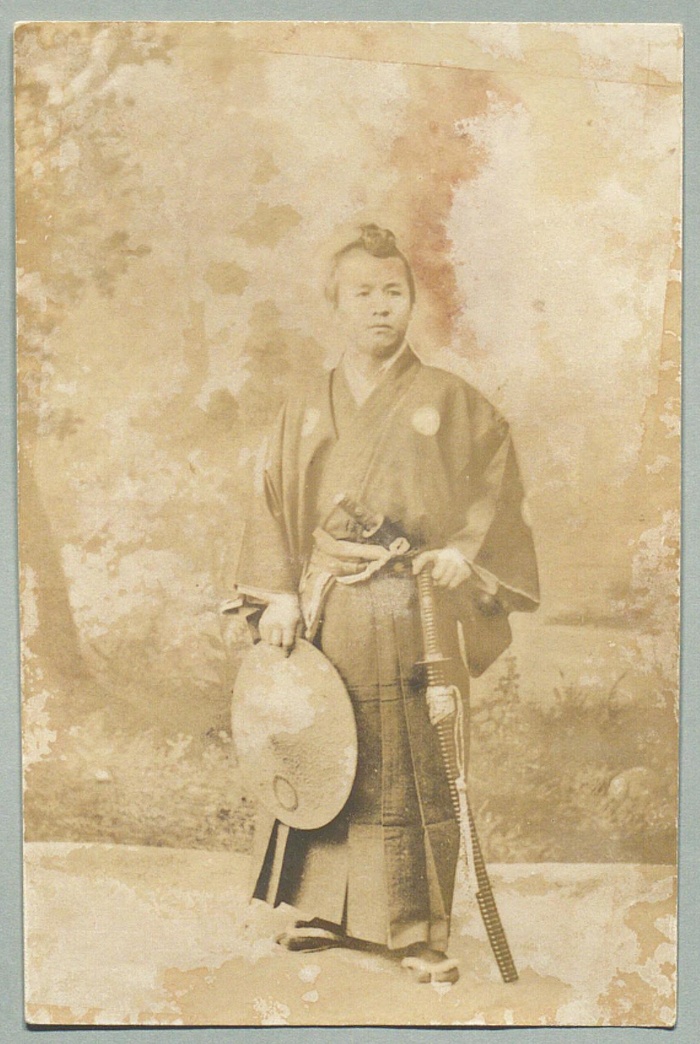
- What it is: a photograph of a young samurai (a member of the hereditary warrior class), with two lines written in pen on the back.
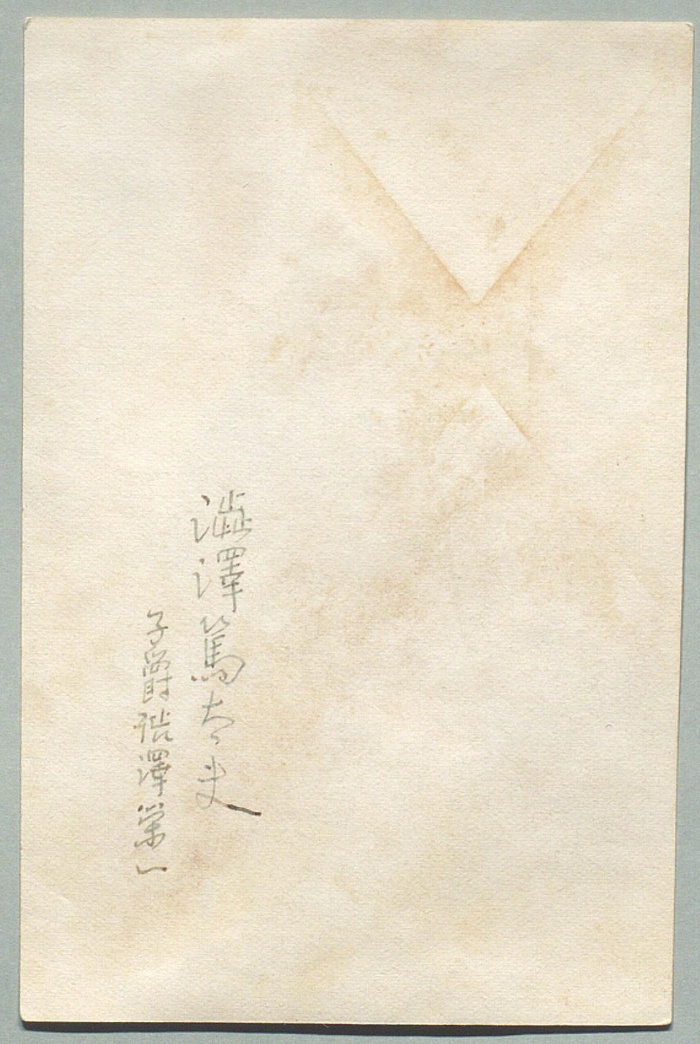
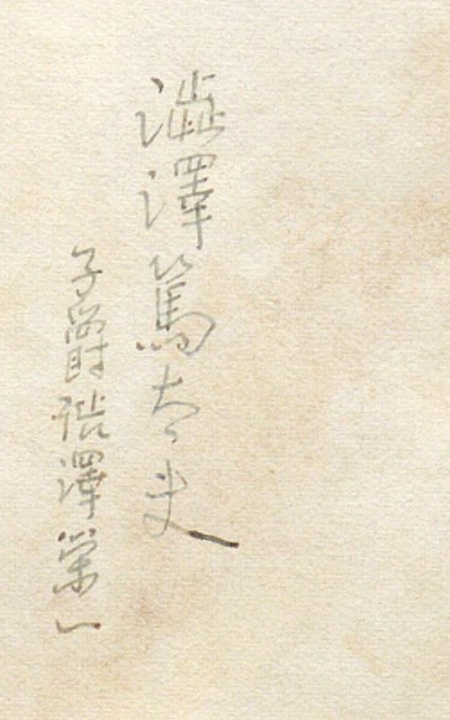
- What it says: two names of one man, one of the founders of modern Japanese business. Line 1 is Shibusawa Tokudayū (澁澤篤太夫), a name he used in the 1860s. Line 2 is Viscount Shibusawa Eiichi (澁澤榮一); viscount is a noble rank he received in 1920. Names are written surname first, as in Japan.
- When: the photo was most likely taken before he went to Europe in 1867; the second line was written in 1920 or later.
- How sure we are: every character is readable. One is written in a shortened form (see note ① in section 4).
1. The item
A photograph of a young man, on a stiff card backing about 6.5 by 10 cm (2.5 by 4 in). We measured the card against the scale in the library's image.
He stands in front of a painted backdrop. He wears a kimono (a Japanese robe) bearing a family crest (mon) and pleated trousers (hakama). He has two swords at his waist and his hair in a topknot. He holds a round, flat hat. On the back, two lines are written in pen, top to bottom.
2. Transcription and translation
Japanese written top to bottom is read from the right-hand line to the left-hand line, so line 1 is on the right. We copy each line character by character, then translate it.
| Transcription | Translation |
|---|---|
| 澁澤篤太夫 | Line 1 (right): Shibusawa Tokudayū |
| 子爵澁澤榮一 | Line 2 (left): Viscount Shibusawa Eiichi |
3. Notes on the names, titles and dates
- Shibusawa (澁澤). A family name. Both characters are written in their older forms. Today his name is usually written 渋沢栄一. Japan adopted simplified forms for everyday use in 1946.
- Tokudayū. An everyday name: the name a man went by in daily life. Shibusawa Eiichi (1840–1931) used several everyday names in his life. He used this one from 1864, when he entered the service of the Hitotsubashi 一橋 house, a branch of the family of the Tokugawa (徳川) shoguns, Japan's military rulers until 1868.
- Viscount (子爵, shishaku). A rank of the Japanese peerage (the hereditary nobility, which existed from 1884 to 1947). Shibusawa was made a baron in 1900 and raised one rank, to viscount, in 1920. Japan also counts years by imperial era, and 1920 is Taishō 9, the ninth year of the Taishō era (1912–1926). This title is what dates line 2.
- Eiichi. His given name. Eiichi is the usual reading of these characters.
- Who wrote them. The two lines may have been written at different times: line 2 was written in 1920 or later, while line 1 gives a name he used in the 1860s. The back does not say who wrote them.
- When the photo was taken. He wears the topknot and two swords of a samurai. In 1867 he went to the Paris world's fair (the Exposition Universelle) with the shogun's younger brother. He cut his topknot during his stay in Europe in 1867–68, so the photo was most likely taken before then.
4. Notes on uncertain readings
- ① In line 2, the character 榮 ("Ei" of Eiichi) is written quickly, in a shortened form close to the simplified 栄. The older form 榮 was standard in his day. Both read "Ei," so the name reads the same either way.
On other items, where a character cannot be read, we put a question mark in its place in the transcription. Where two readings are possible, we give both, with our confidence in each.
5. What this means for a family item
On a family photo, the same kinds of clues can date the picture and the writing. For example, a great-grandfather's photo may carry a name he used only when young, a title he held for a time, or an older form of a character. In a reading for your family, this section says what the item tells you. It also names a record that could take it further, such as the koseki of the person named.
Sources
- The item: a photograph held by a national library, in a collection of private papers; 1 sheet, with writing in pen on the back. The library marks this item as public domain (copyright protection expired) and allows free reuse without application. We cropped the images.
- The everyday name Tokudayū, used from 1864 by Shibusawa Eiichi, and the cutting of his topknot in Europe: a general reference work (in Japanese).
- Shibusawa Eiichi's life (1840–1931), his service with the Hitotsubashi house, his journey to Paris in 1867 and his ranks: a published chronology of his life (in Japanese).
- His rank of viscount in 1920: a detailed published chronology of his life (in Japanese).
Have a photo, gravestone or letter you cannot read? — from $79
Up to 80 Japanese characters is $79. That covers the writing on the back of a photo, a gravestone, a memorial tablet or a short note. How it works:
- Tell us about the item first.
- We email you a private upload code. With it, you send us the photo through our upload page.
- We check that your images are readable and talk it over with you. You pay only after that. If we cannot read it, we tell you so and do not take the order.
- Your PDF arrives in about a week after we receive your images.